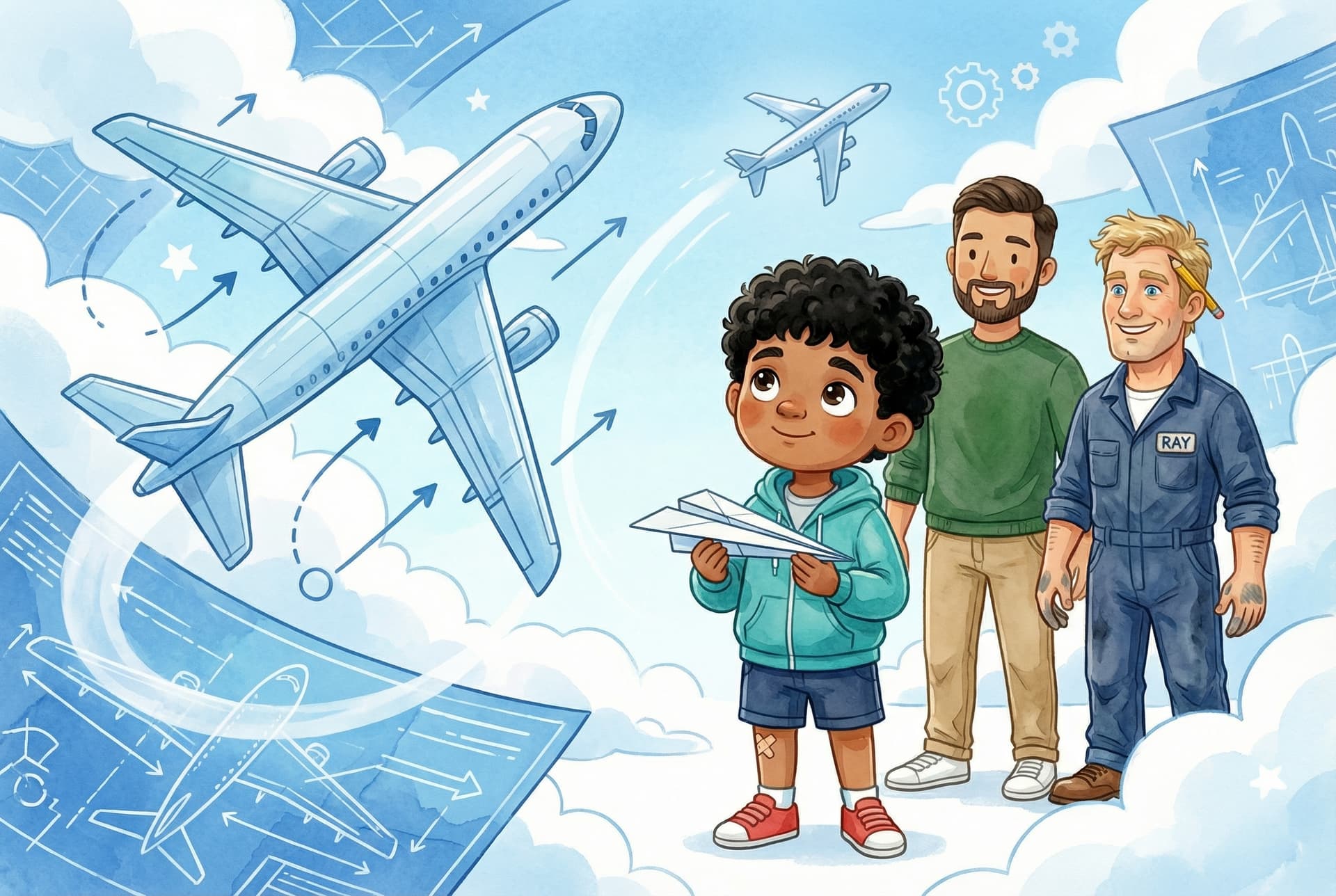

Could a plane really stay up in the sky, even when it was so heavy?
Kelvin asked that question as he sat on the porch steps, hugging his knees. A paper flyer lay beside him, bent at the nose. The breeze pushed it, and it slid like a sleepy fish across the wood.
“Planes are like big questions,” Dad said, stepping outside with two cups of warm cocoa. He set one cup near Kelvin’s hands. “Want to find an answer the real way?”
Kelvin’s tummy felt wiggly—excited and a little scared. He nodded.
They walked to the small airport at the edge of town. It smelled like grass, sunshine, and something oily, like a bicycle chain. Inside a wide hangar, a shiny airplane sat quietly, as if it were taking a nap.
A mechanic looked up from a tool cart. His name tag said **Ray**. Ray’s hands were smudged with gray, but his smile was bright.
Kelvin stayed close to Dad’s side. Dad squeezed Kelvin’s shoulder—gentle, like a seatbelt click.
Ray knelt so his eyes were level with Kelvin’s. “First time in a hangar?”
Kelvin nodded. “I want to know how planes fly.”
“Then you came on the right day,” Ray said. “Today we’re doing three checks: build, balance, and lift.”
Kelvin liked how Ray said it. Three checks sounded like a quest.
Ray led them to a table with drawings covered in lines and arrows. “These are blueprints. They tell builders where every piece goes. A plane is made like a giant puzzle.”
Kelvin traced a line with his finger. “What’s this long part?”
“The **fuselage**,” Ray said. “That’s the body. It holds seats, cargo, and controls.”
He tapped two wide shapes. “These are the **wings**. They’re built with strong ribs inside, like a kite with a skeleton. The skin is usually special metal—light but tough.”