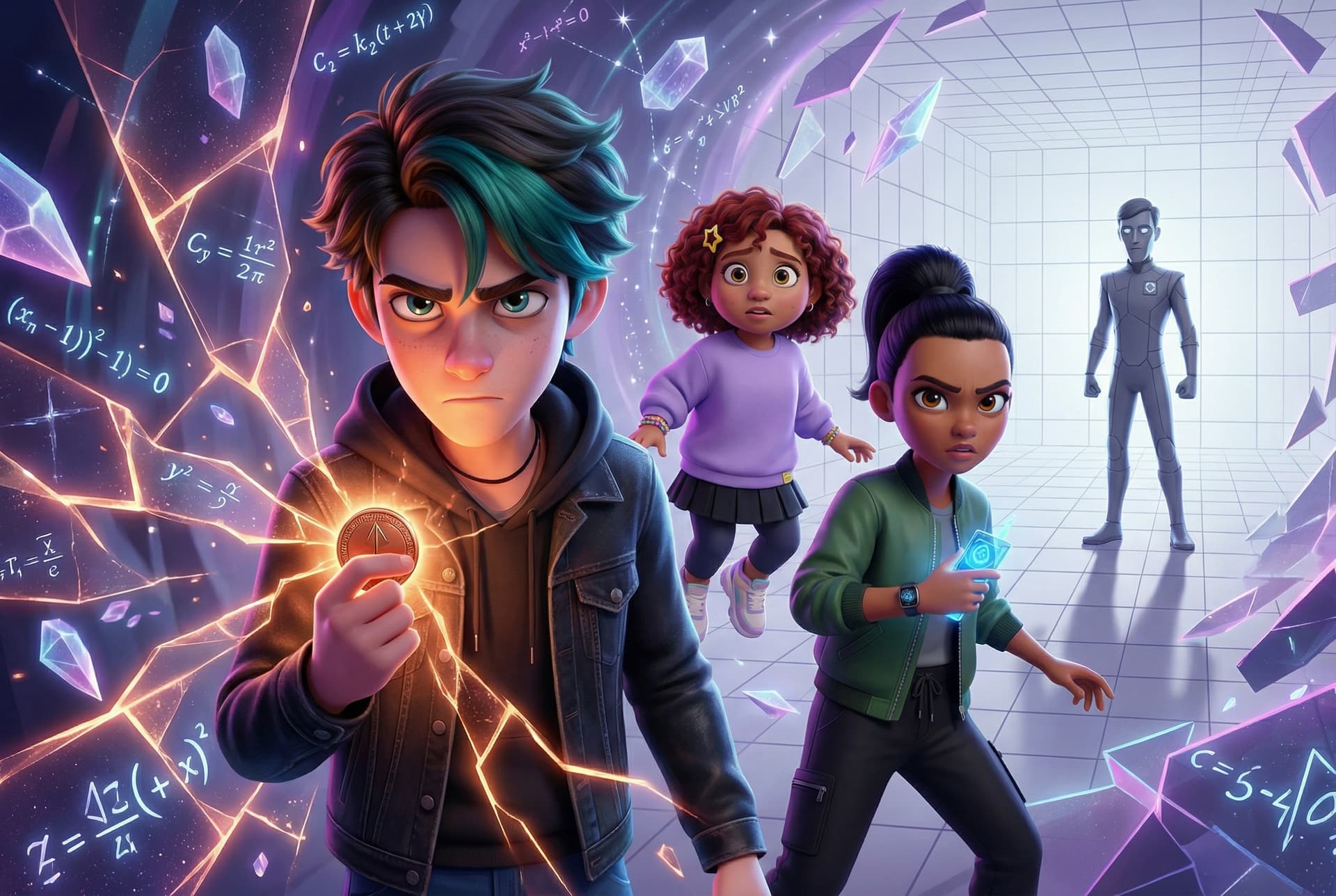





The air split like fabric.
Casey’s fingers cramped around the copper coin as the lab corridor lurched sideways, floor twisting into wall. A ribbon of darkness—sanitized, absolute—poured from the cracked door ahead, smoothing posters into blank rectangles. It didn’t just destroy; it corrected.
“Casey!” Jodi’s voice punched through the alarms. “We’re out of time!”
“No.” The word scraped his throat. His thumb rubbed the coin’s ridged edge, a grounding habit he’d clung to since he was eight. Now it was the only thing that felt real.
The door to Dr. Marris Vale’s office hung open. Inside, where his parent should have been, there was only the Array.
The higher-dimensional lattice of glass rods and humming rings stood in the center of the room like a sculpture built by someone who hated gravity. Light bent around it wrong.
The darkness crept forward. It erased. It simplified. A paper on the desk—Casey’s half-finished calculus homework—fluttered, then froze as the dark brushed it. Messy scribbles straightened into neat, typed lines. Correct. Cold.
Pulse hammering at his jaw, Casey stared at the monitor on the far wall.
**IF YOU FOLLOW, DO NOT FOLLOW.**
Beneath it, a coordinate string shimmered in a language for spaces between spaces.
Jodi grabbed his sleeve. She was two years younger but always looked like she’d already read the instructions. “Your parent isn’t here. We need to go.”
“That’s the problem.” Panic turned Casey’s mouth sharp. “They’re not here.”
The darkness reached the threshold.
Casey moved before his brain caught up. He slammed the copper coin—the stupid access key Dr. Vale called “my anchor”—into the Array’s central slot.
The rings sang. The world folded.
***
Gravity returned in shards.
Casey hit something that felt like sand, but sand didn’t hum. His lungs seized, then dragged in air with a painful gasp.